Strategy Over Hype: Unlocking AI’s Full Potential for Enterprises and Governments

AI is reaching new dizzying heights with bigger models, more compute and a flood of pilots chasing transformation. Yet, inflated by compute hoarding and headline-driven hype, many efforts deliver little substance. As the altitude rises, so does the need to stay grounded. Reality is catching up.
That’s why, from the start, we’ve approached things differently. We don’t chase scale for its own sake. We focus on what actually drives transformation.
While others rushed to demo chatbots and pursue rapid expansion, we’ve been building deliberately in close partnership with those who understand that real transformation doesn’t come from pilots alone, but from purposeful focus, well-planned integration and meaningful adoption. And sure, pilots are inevitable in the beginning, but what differentiates the successful ones is what comes next.
At Aleph Alpha, we co-create sovereign systems that solve real problems. Our Solution Factory team works directly with enterprises and governments to build AI use cases that integrate deeply, scale sustainably and deliver measurable value. Not someday. But now.
The recent MIT NANDA report, The GenAI Divide: State of AI in Business 2025, confirmed what we’ve long predicted: 95% of generative AI pilots fail. It’s not because the tech isn’t powerful, but due to misalignment, misunderstanding and misapplication. In fact, the report found that internally built solutions fail twice as often as specialized ones developed with external partners. What seems convenient at first often comes at a cost and rarely delivers the impact organizations hoped for.
As co-founder, Jonas Andrulis puts it, “The future of AI won’t be won by the biggest model. It’ll be won by the system best tailored to the right problem.”
That’s what we’ve been building, with presence and purpose alongside our partners. Not brittle tools that patch over surface-level inefficiencies, but robust sovereign AI technology designed to address the complex and critical challenges enterprises face like fragmented knowledge, slow decision cycles and legacy systems that resist scale.
We’re building sovereign AI that lasts.
Most leaders already know that real transformation can’t be solved with a simple chatbot. That belief is largely behind us. But even with clearer expectations, many initiatives still fall short. And that’s not because the ambition isn’t there, but rather the execution is simply misaligned. Quick fixes and hastily integrated tools often fail to deliver lasting impact, especially when applied in siloed processes without strategic alignment.
Our Solution Factory team has seen this firsthand. Chatbots may be the most familiar face of AI, but true transformation in enterprises and government runs far deeper.
And as Gartner highlights in their recent articleAI Shockwaves: The Real Disruptors Beyond the Productivity Boom, “Strategic partnerships with startups and open ecosystems will be critical to sensing and shaping the next big AI shockwave.” From our perspective, this isn’t just a prediction, but rather a reflection of how we’ve always worked.
So, what does it really take to master AI at scale and stay on top of the shockwave?
Here’s what we believe it takes to move beyond the hype and build AI that lasts:
1. Understand what successful AI adoption really requires.
Many AI initiatives fail to scale because organizations overlook the conditions needed for adoption to thrive. Solutions often misalign with real workflows, face resistance rooted in company culture, lack executive sponsorship or fail to demonstrate clear business value. And when practical hurdles, like infrastructure readiness and the economics of scaling AI, remain unresolved, momentum quickly stalls.

One major barrier lies in the non-deterministic nature of AI. Models learn patterns from data to generate outputs. That makes them powerful, but unpredictable. Even the most advanced chatbots sometimes hallucinate, like once suggesting “non-toxic glue” to make cheese stick to pizza. Now imagine similar unpredictability in HR, legal or engineering decisions, domains where AI could deliver the greatest value yet also pose the highest risk.
2. Ask the right questions before you scale.
Successful GenAI transformation across large organizations requires more than experimentation. It requires discipline, strategy and strong foundations. Leaders must grapple with pressing questions such as:
- How do we ensure the context data is relevant and up to date?
- Can we safely include sensitive or personal data?
- Can we trust AI to interact directly with customers?
Handling these questions early ensures that scaling AI is sustainable and secure, without turning ambition into risk.
3. Follow our approach to turn AI into real value.
We view transformation not as a chatbot rollout, but as a value unlock in core processes. This requires an all-encompassing approach that balances business value, domain expertise and technical rigor. Based on our experience across enterprise and government projects, we’ve identified five key steps that help AI move from concept to capability:
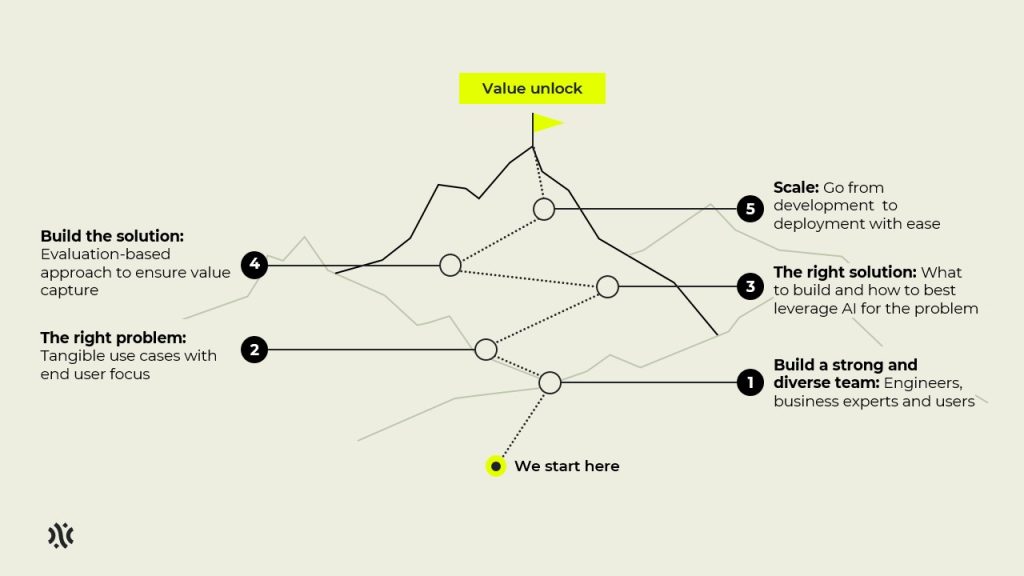
- Build a skilled, cross-functional team engaged from start to finish, end-to-end. By this we mean, ensure your team includes domain experts, data scientists, engineers and product owners who collaborate across the entire lifecycle, from problem framing to deployment.
- Identify the right problem. Not every problem is an AI problem. Focus on problems where AI can create measurable impact and where data availability supports meaningful solutions.
- Design a solution tailored to the workflows it must support. Your AI solution should integrate seamlessly into existing processes, enhancing, not disrupting, the way people work.
- Build, measure and optimize against the metrics that connect directly to business outcomes. Define success using metrics that tie directly to strategic goals. Continuously iterate based on performance and feedback.
- Choose the right tools to scale beyond proof of concept (POC). Select technologies and platforms that support robust deployment, monitoring and long-term scalability, so your AI moves confidently from pilot to production.
Drawing on our experience from numerous projects at Aleph Alpha, these steps provide the groundwork and traction to ensure AI doesn’t remain an abstract capability. Instead, AI becomes an embedded part of how teams work and innovate every day.
4. Select use cases that matter.
But how do you identify a use case worth pursuing, rather than applying AI unselectively? Before investing, ask:
- Do you thoroughly understand the problem? Is there clear business value and a measurable outcome?
- Is AI the best fit for this context, or could a more conventional approach solve it just as well?
- Do you have test users to calibrate and evaluate the solution and IT support to integrate it into real workflows?
Without these checks, organizations risk investing time and energy into use cases that never progress beyond pilots. Addressing these questions early allows use cases to scale with confidence.
5. Match the approach to risk and context.
Once you have the right use case, the next question is: what kind of AI approach fits? Use cases can be mapped across two key dimensions:
- Risk level: high vs. low
- Process variability: repeatable vs. dynamic
Each combination calls for a different solution:
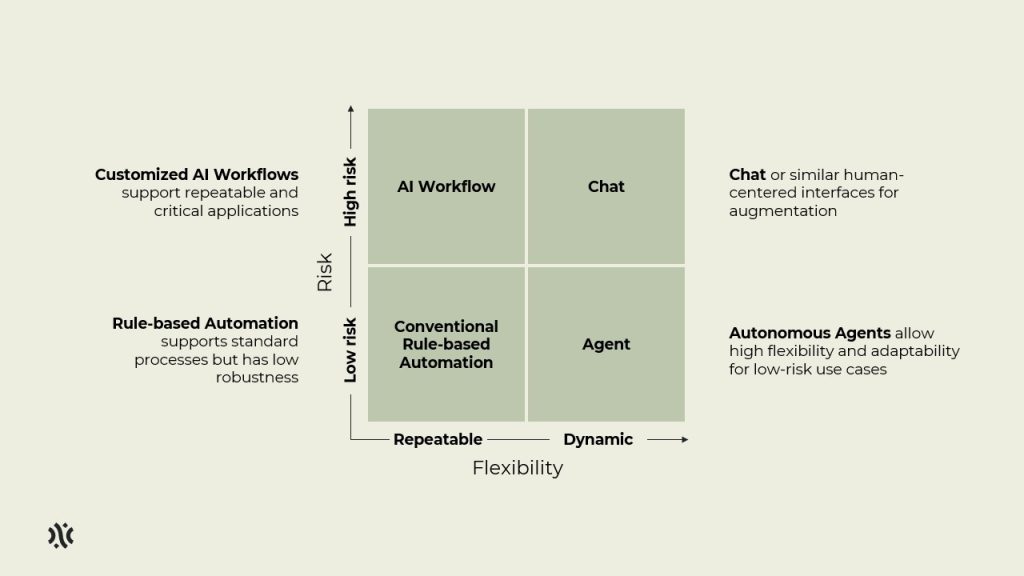
- High risk + repeatable → Custom AI workflows
Example: A software tool with a custom user interface that uses AI logic to identify and fix functional architecture issues in autonomous vehicles. - Low risk + dynamic → Autonomous agents
Example: A search agent that finds information in documents and autonomously expands its search by accessing linked documents and executing queries on internal databases. - High risk + dynamic → Human-supervised AI assistants (i.e. chat, co-pilot models)
Example: An AI copilot that assists software developers by generating code, suggesting improvements and supporting complex tasks, while keeping humans in full control. - Low risk + repeatable → Traditional rule-based automation
Example: Automatically sorting IT support tickets by keywords and urgency using fixed rules.
This framework helps organizations avoid overreach or underuse, when deploying AI, ensuring its full potential is matched to the right context.
6. Scale beyond POC to unlock lasting value.
Once innovation is validated in a POC , the challenge becomes scaling it across the organization. In our experience, this transition requires a deliberate, three-stage approach:
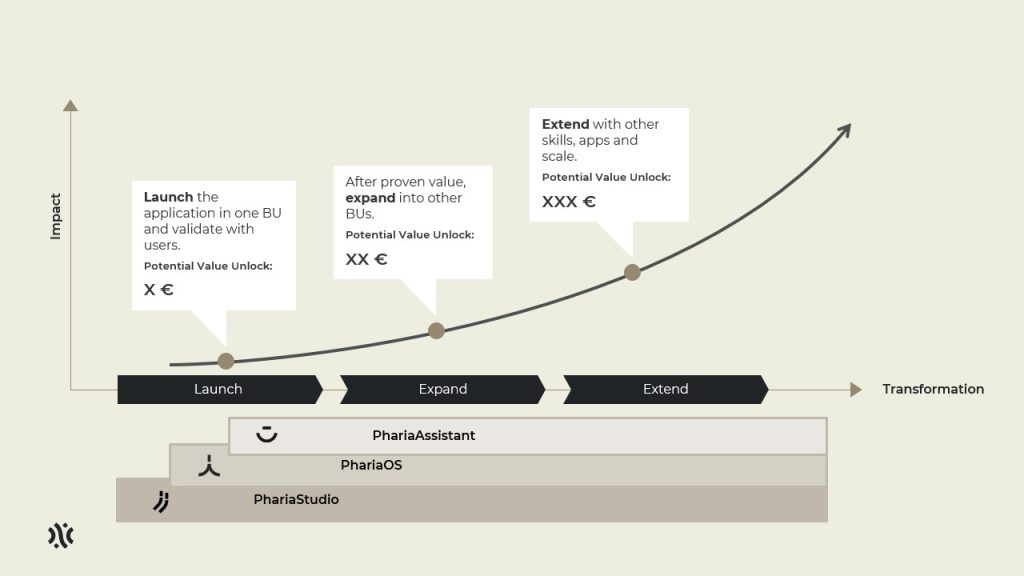
- Launch: Develop the application within a business unit, validating and assessing the solution in collaboration with users.
- Expand: Scale horizontally across units in adjacent processes and datasets.
- Extend: Add new skills, ensuring seamless interfaces with people and tools.
This progression helps organizations embed GenAI sustainably into core operations, unlocking long-term value through cost savings, efficiency gains and improved decision-making.
Harnessing AI isn’t about experimentation alone. Organizations must embrace a strategic, deliberate approach. By carefully selecting the right problems and tailoring solutions to real-world needs, enterprises and governments can drive lasting competitiveness, resilience and long-term value. With ourPhariaAI stack, we help organizations move from an idea to meaningful execution.
Ready to go further?
For a deeper dive into how to build impactful GenAI products and lead successful AI transformations, watch our video from the Aleph Alpha Academy. In it, you’ll gain insights from our Solution Factory and Product teams, offering complementary perspectives to help guide your next AI initiative.
Stay tuned for more insights from our Solution Factory team, where we’ll share real-world examples of how our unique approach solves customer challenges and delivers measurable business value.
Author
